
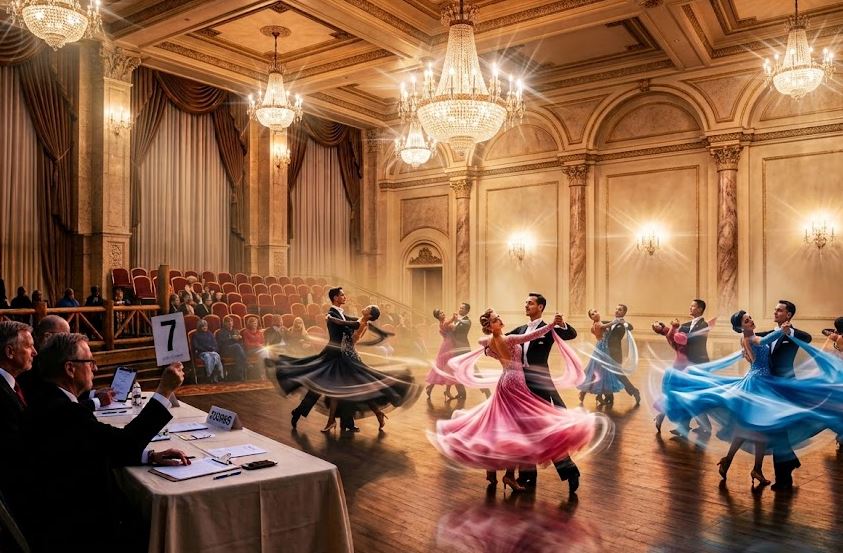
How Does DanceSport Judging Work in Canada?
Ever watched a DanceSport competition and wondered why one couple placed ahead of another? Or why a couple that looked great in the final didn’t win?
DanceSport judging can seem mysterious, but understanding the basics makes competitions much more interesting. Here’s how judges decide who advances, how final results are calculated, and what they’re looking for on the floor.
1. From Heats to Finals: How Couples Advance
Most DanceSport competitions begin with preliminary rounds, often called heats. Depending on the number of entries, these may include quarterfinals and semifinals before the final.
In these early rounds, judges compare the couples and mark which ones they want to see advance. They don’t assign each couple a numerical score or rank them from first to last. Instead, they select couples they believe merit moving forward.
The marks from the judging panel are tallied, and the couples receiving enough selection marks advance to the next round.
The key takeaway: You don’t need to win a heat. You need to earn enough judges’ selections to keep going.
2. How Are Final Placements Decided?
In a traditional DanceSport final, judges rank the couples in each dance, from first place onward. In a six-couple final, for example, each judge assigns places from first to sixth, without giving the same place to two couples.
These individual rankings are then combined using the applicable scoring rules, commonly known as the Skating System.
Despite the name, the system isn’t simply about adding up scores or counting first-place votes. It uses a set of rules to determine each placing, including procedures for resolving ties and comparing the judges’ rankings.
Each dance is assessed separately. In a multi-dance event, the results across the dances are then combined according to the competition’s rules to determine the overall winners.
Why can the results surprise you? Because judges are evaluating the couples relative to one another. A performance you love may not be the one that ranks highest across the judging panel.
For the official explanation, see the World DanceSport Federation’s guide to declaring winners.
3. What Are Judges Looking For?
DanceSport is about much more than remembering the steps. Judges assess a combination of technical and artistic qualities, including:
- Technique: Posture, footwork, balance, and accurate execution.
- Musicality: Timing, rhythm, and interpretation of the music.
- Movement: Body action, dynamics, and the quality of movement across the floor.
- Partnership: How effectively the dancers work together.
- Presentation: The character, expression, and overall quality of the performance.
The emphasis can change as the competition progresses. Preliminary rounds tend to focus on fundamental competence, while later rounds allow more sophisticated qualities and artistic expression to distinguish the couples.
Judging is comparative, so a technically sound performance may still place below one that combines strong technique with more compelling movement, musicality, and partnership.
4. Does Your Competition Level Matter?
Yes. The rules governing permitted figures and choreography depend on the competition and category.
In syllabus categories, dancers are generally restricted to figures permitted at their level, such as Bronze, Silver, or Gold. Higher-level categories may allow open choreography.
Before competing, check the current rules for your event. Don’t assume that every Canadian competition uses identical syllabus restrictions.
Whatever the level, the goal is the same: dance within the rules and demonstrate the strongest performance you can.
5. Are All DanceSport Competitions Judged the Same Way?
No. The traditional comparison-based approach is widely used, but some WDSF competitions use an alternative called the Absolute Judgement System (AJS).
Rather than ranking couples directly against one another, AJS assigns numerical marks to four components:
- Technical Quality
- Movement to Music
- Partnering Skills
- Choreography and Presentation
This approach can provide more detailed information about different aspects of a performance. However, it is used at applicable events, not automatically at every high-level competition.
You can explore the WDSF’s overview of DanceSport judging systems for more information.
6. Who Judges the Judges?
DanceSport adjudicators work within qualification, education, and conduct frameworks established by the relevant governing bodies. WDSF has its own licensing and education requirements for international officials, while national and regional competitions follow their applicable rules.
Using a panel of judges helps ensure that results reflect multiple assessments rather than a single person’s opinion. However, no judging system can eliminate every difference in individual judgment.
The aim is to make decisions as consistent, fair, and transparent as possible.
What Does This Mean for You?
Understanding adjudication can help you approach competition with a clearer perspective:
- In preliminary rounds: Aim for a consistent, technically sound performance that earns judges’ selections.
- In finals: Focus on what distinguishes your dancing from the other couples, not just on executing the steps correctly.
- At every level: Know your competition’s rules and understand what judges are assessing.
And remember: one competition result is a snapshot of how your dancing was evaluated on that day. Use it as information, keep developing your skills, and enjoy the process.
The more you understand what happens on the judging panel, the more you can appreciate what makes a great DanceSport performance.